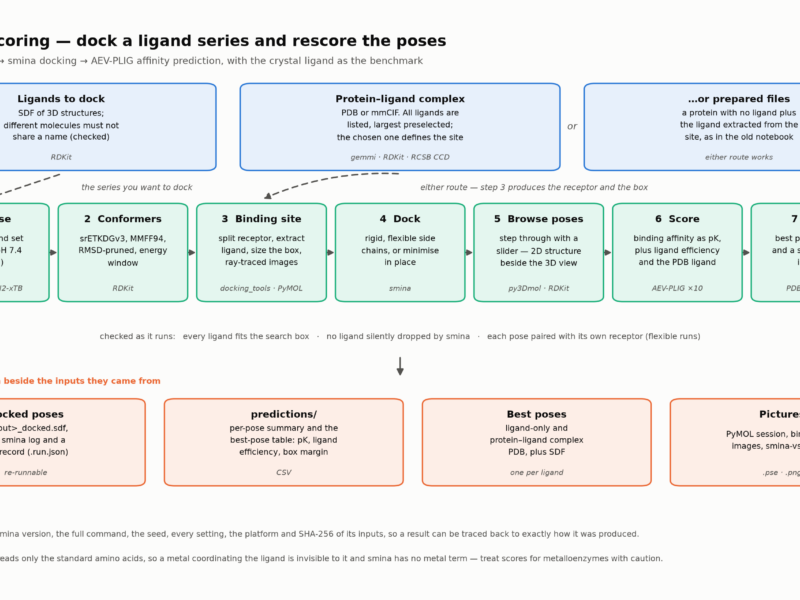
On October 14th the OpenBind Blind Challenge was launched, the target is the Zika virus NS2B-NS3 protease.
This challenge focuses on predicting how small molecules bind to the Zika virus NS2B-NS3 protease. We invite the molecular modelling community to predict protein–ligand complexes for 400 compounds, spanning small fragments to larger, lead-like molecules. Our aim is not simply to produce a leaderboard, but to understand where methods succeed, where they fail, and how they can be improved
Having just updated the docking scoring Jupyter notebook I thought it might be interesting to provide a version for the blind challenge. This notebook could perhaps be modified to try different docking algorithms or alternative scoring functions.
As the website highlights structural studies have shown that the ZIKV NS2B-NS3 protease can adopt several conformations involving rearrangement of the NS2B cofactor: a closed conformation, an open conformation, and a super-open conformation. The open and super-open conformations are considered proteolytically inactive, as the C-terminal part of NS2B that contributes to the substrate-binding site is unstructured in these conformations.
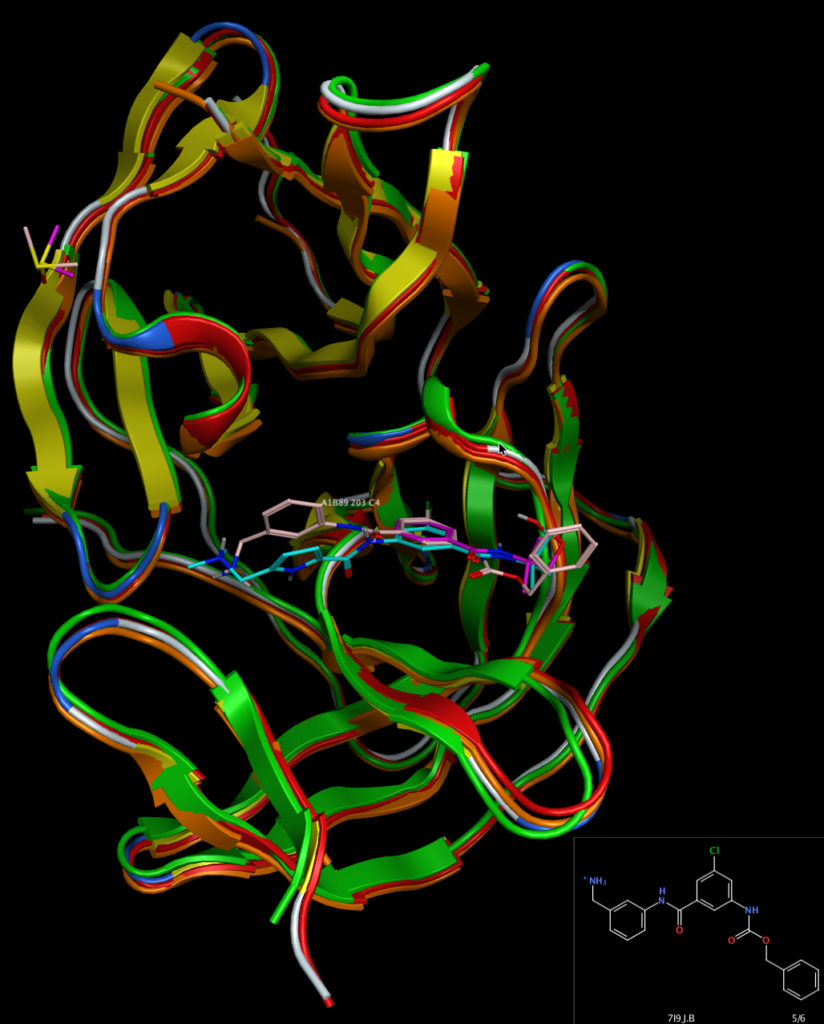
The focus been on the closed conformation of NS2B-NS3, using a bicistronic vector to co-express the NS2B cofactor and the NS3 protease. This optimised system gave us crystals in the P4322 space group with only one NS2B-NS3 complex in the asymmetric unit and an accessible active site, ideal for fragment screening and ligand soaking (PDB code: 29HN). This structure has no ligand bound, but there are several other structures in the PDB that contain a bound ligand including 7H1J and 9RM4. All three structures were imported into MOE and the structures prepared. They were then superimposed as shown below.
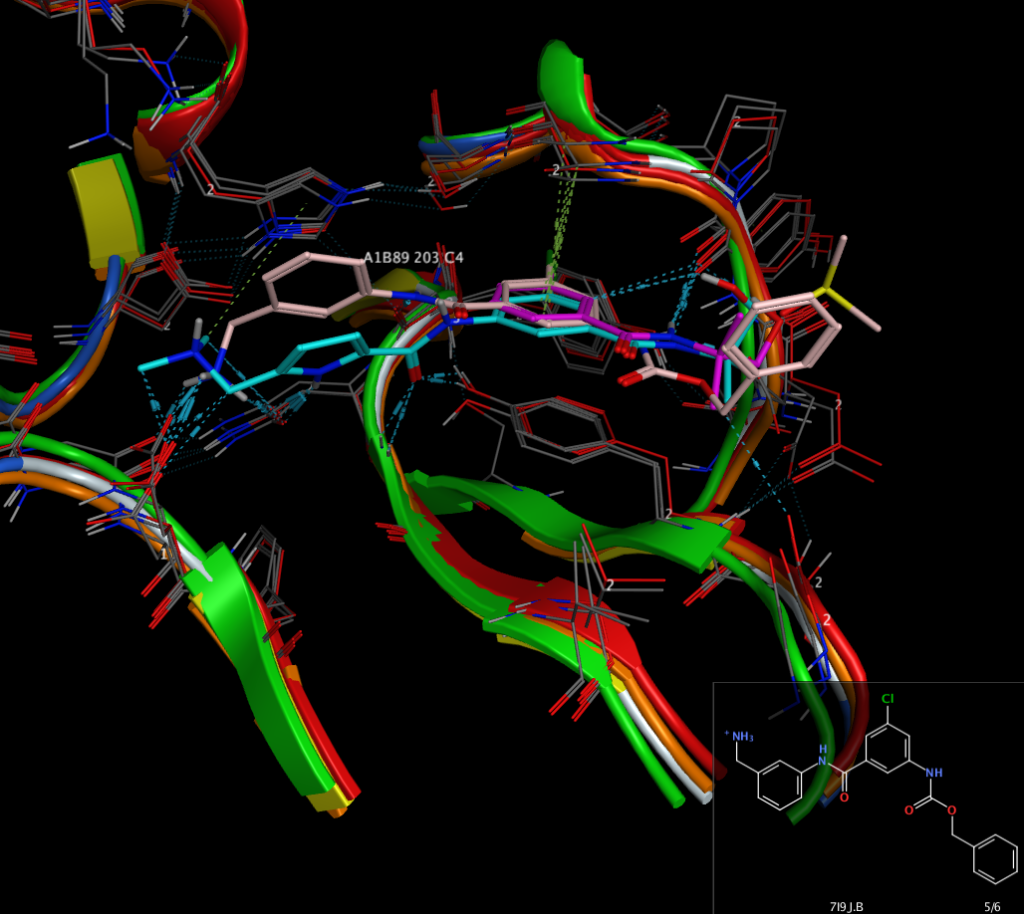
A close up view of the binding site is shown below.
And the key ligand interactions are shown here.
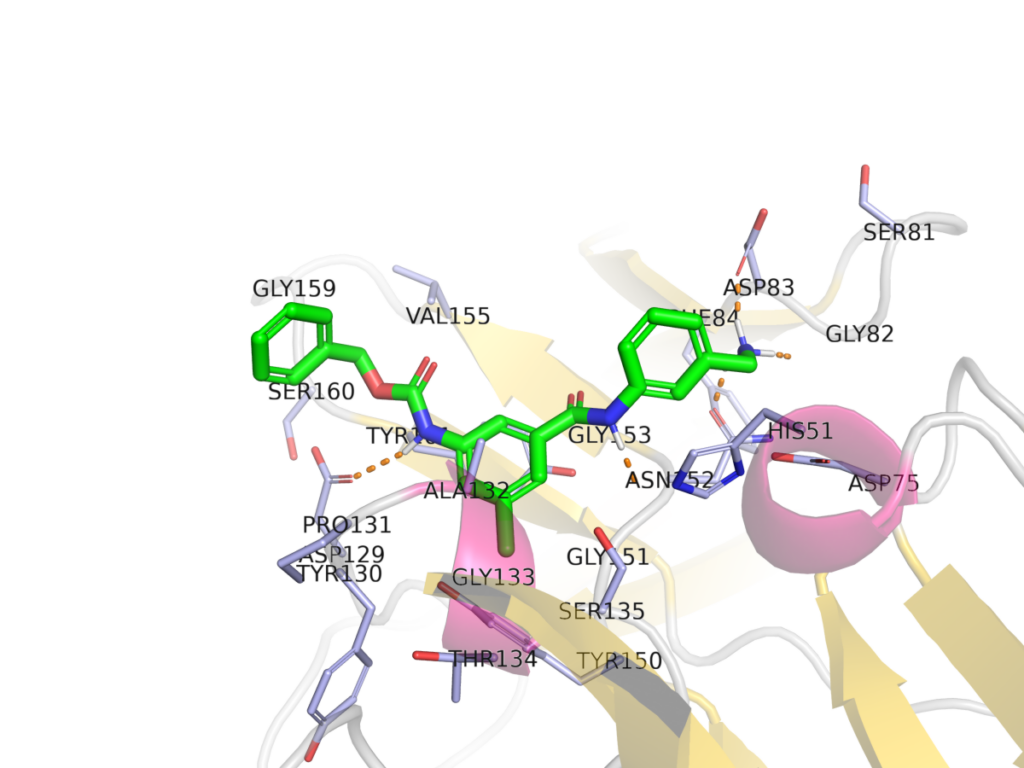
This ligand was copied into the binding site of the superimposed structure 29HN and minimised. This was then exported in pdb format and used for the docking studies.
The notebook used for docking can be seen here, this version actually only docks a trial 10 compounds to test the process. In this html version the sliders to scroll through the poses don’t work but you can download the actual notebook at the bottom of the page.
After docking the poses are scored using AEV-Plig and the best scoring poses for each ligand is exported as both a pdb file and as a PyMOL session file.
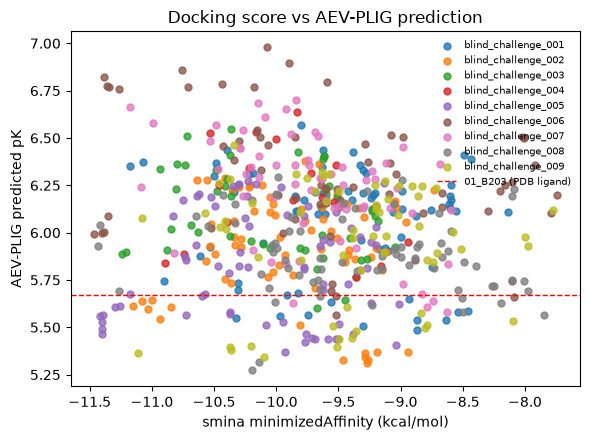
As you can see from the plot below there is little correlation between Smina docking score and the AEV-plig score.
The notebook and associated files can all be downloaded from GitHub https://github.com/drc007/zika_docking